A new bipartisan survey reveals that 66% of Iowans support a significant increase in tobacco taxes, viewing it as a critical public health intervention to address the state’s rising cancer mortality and Medicaid shortfalls.
A recent survey by the Iowa Health Initiative shows that two-thirds of Iowa voters, across all political affiliations, support a $1.50 tax increase on cigarettes and nicotine products. Bipartisan lawmakers and medical experts argue this measure is essential to curb the state’s disproportionately high lung cancer rates and generate critical revenue for Medicaid, which has not seen a tobacco tax adjustment since 2007.
Bipartisan Support for a Public Health Tax
As Iowa lawmakers debate strategies to address state healthcare funding, a new survey conducted by The Strategy Group Co. indicates overwhelming public support for increasing taxes on tobacco and nicotine products. Polling 615 voters between late February and early March 2026, the data revealed that 66% of Iowans favor a $1.50 cigarette tax increase.
This proposal stands out as the only tax measure to secure majority approval; by contrast, only 17% of respondents supported increases to gas or sales taxes. The support for the tobacco tax crosses traditional political lines, with 77% of Democrats, 65% of Republicans, and 60% of independents in favor. Even among current tobacco users, 44% expressed support for the measure.
The Clinical Urgency: Iowa’s Cancer Crisis
The push for the tax increase is heavily driven by alarming public health data. Iowa currently suffers from significantly higher instances of lung cancer and mortality rates compared to both the national average and neighboring Midwest states. Data indicates that one-third of Iowa’s cancer deaths are directly related to tobacco use.
Dr. Richard Deming, a prominent cancer care provider, highlighted the stagnation in the state’s prevention efforts. “Iowa has not increased the cigarette tax since 2007, almost 20 years,” Deming stated. “Our smoking rate today is 12.9% compared to the national average of 9.9%.”
Medical professionals, including Dr. Mary Charlton, director of the Iowa Cancer Registry, emphasize that raising the tobacco tax is the “single most impactful public health intervention” available to reduce cancer deaths. Experts warn that a smaller increase—such as the 65-cent hike previously proposed by Gov. Kim Reynolds—would be insufficient to actually deter people from starting or continuing to smoke.
Legislative Action and Medicaid Funding
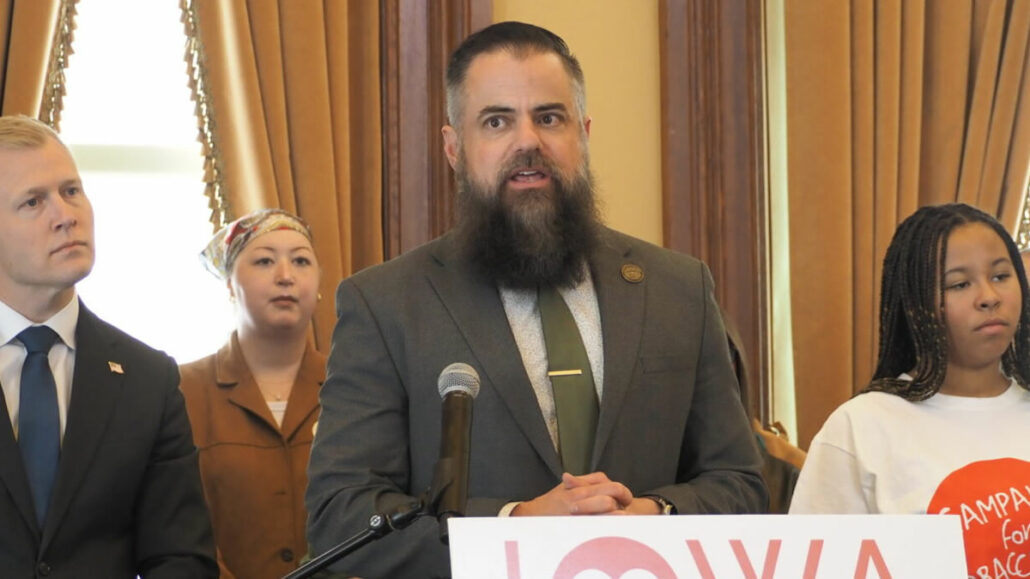
The survey results bring renewed momentum to House File 2406, introduced by Rep. Brett Barker (R-Nevada). Although the bill has yet to be scheduled for a subcommittee hearing, Barker views the polling data as proof that even conservative voters support the policy.
Rep. Austin Baeth (D-Des Moines), a physician, joined Barker in a rare display of bipartisan unity, stating that preventing youth addiction and fighting cancer “should not be a partisan issue.”
Beyond public health, the proposed $1.50 tax increase offers a strategic financial solution. Iowa is currently facing a significant Medicaid shortfall. While lawmakers are considering controversial tax hikes on health maintenance organizations (HMOs) to cover the deficit, Barker suggests the tobacco tax is a more voter-approved alternative. He described the proposal as a “win-win-win solution”—saving lives, reducing tobacco use, and securing critically needed state revenue.